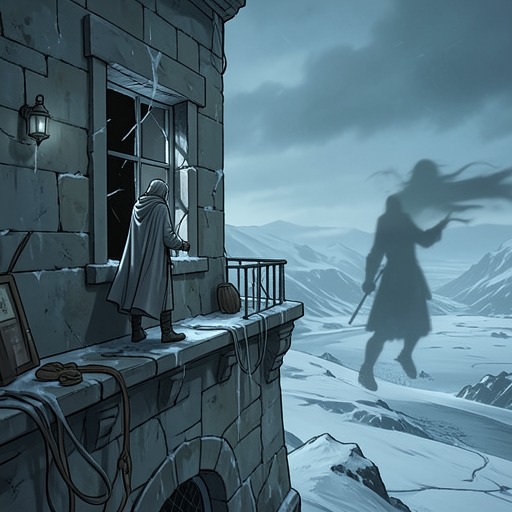
Greyjoy invasion of the North
A Clash of KingsThe Greyjoy invasion of the North is a maritime campaign by House Greyjoy that turns the North’s exposed coastline and weakened defenses into instruments of conquest. Lord Balon Greyjoy presents the invasion not merely as a bid for a crown but as an attempt to restore the Old Way, while the campaign’s raids, burnings, enslavement, and projected seizure of Moat Cailin reveal the human and strategic cost of that ambition. Its immediate violence is carried out by Theon Greyjoy, Asha Greyjoy, and Victarion Greyjoy, but its consequences extend from fishing villages to Winterfell and the balance of the War of the Five Kings.
Origins and Strategic Design
The invasion grows from the political moment created by the War of the Five Kings. Robert Baratheon and Eddard Stark, who had previously crushed Lord Balon’s rebellion, are dead, and Balon judges the realm to be fractured under inexperienced rulers. He regards the southern war as the opportunity the Iron Islands have been waiting for: the great lords of the North have gone south with Robb Stark, leaving behind what he dismisses as old men, inexperienced boys, and cowards.
Balon’s ideology is rooted in the Old Way, the ironborn tradition of taking wealth, women, and glory by force rather than producing them through mines, farming, or trade. Aegon the Dragon destroyed that order when he burned Black Harren, restored Harren’s kingdom to the rivermen, and reduced the Iron Islands to a marginal part of a larger realm. Yet the old stories remain powerful, and the Greyjoy words, “We Do Not Sow,” preserve the claim that reaving is the ironborn’s proper labor. Balon’s new offensive therefore seeks both territorial expansion and cultural restoration.
The campaign is divided among the Greyjoy commanders. Theon is ordered to take eight longships north and harry the Stony Shore, burning fishing villages and sinking any ships he encounters. Aeron Greyjoy and Dagmer Cleftjaw are assigned to accompany him, limiting Theon’s practical independence even while placing him at the head of the first blow. Asha receives the more prestigious task: thirty longships of picked men are to sail around Sea Dragon Point, land on the tidal flats north of Deepwood Motte, and seize the castle before its defenders can respond. Victarion Greyjoy commands the main thrust up Saltspear and the Fever River toward Moat Cailin.
Moat Cailin is the strategic center of the plan. Balon identifies the Neck as the key to the kingdom, and believes that holding the fortress will prevent Robb Stark from returning north. If Robb attempts to force his way back, the southern end of the causeway can be sealed behind him, leaving him trapped. The invasion thus depends on a combination of coastal surprise, inland footholds, and control of the narrow passage joining the North to the rest of the realm.
Raids on the Northern Coast
Theon’s first operations make the invasion visible as terror before its full military purpose is understood. Raiders in longships attack fishing villages along the Stony Shore, plundering, burning, and killing. Maester Luwin recognizes the danger when reports reach Winterfell: the attackers are not merely isolated criminals but organized ironborn forces who can move by sea, strike exposed settlements, and withdraw before a larger army arrives.
The attack on the fishing village demonstrates the campaign’s social logic. The village is reduced to cold ashes; its men are put to the sword except for a few deliberately spared to carry news to Torrhen’s Square. Young and attractive women are claimed as salt wives, while older or less favored women are raped and killed, or enslaved as thralls when their skills make them useful. Theon has planned the attack himself, bringing his ships ashore in darkness and leading the assault with a longaxe. His reluctance does not prevent the violence. He treats obedience to Balon’s war and the need to compete with Asha as reasons to perform acts he does not like.
The death and mutilation of Benfred Tallhart deepen the raid’s political meaning. Theon had expected to meet a local force and ordered its leader spared for questioning, only to discover that the limp body dragged from the surf is Benfred, a northern nobleman. The encounter links the destruction of an ordinary settlement to the wider war. The surviving villagers are intended to spread the false impression that the attack is simply the work of sea raiders seeking plunder, while the larger Greyjoy operations against castles and crossings remain concealed.
The invasion is also foreseen at Winterfell through Bran Stark’s account of Jojen Reed’s green dream. Bran says that water will flow over the walls and that Alebelly, Mikken, and Septon Chayle will drown. Maester Luwin treats such prophecy cautiously, but confirms that trouble is already occurring along the Stony Shore. The dream therefore coincides with military intelligence: supernatural warning and practical reports converge on the same advancing threat.
Castles, Winterfell, and Occupation
The Greyjoy offensive is designed to move beyond raiding into permanent possession. Asha’s planned capture of Deepwood Motte would give the ironborn a secure base in the heart of the North. The castle is vulnerable because Robett Glover and Galbart Glover are away fighting in the south, and Theon knows the stronghold from earlier visits with Eddard Stark. His recognition that he should have been chosen for the assault exposes the personal rivalry inside Balon’s strategy: the campaign is also a contest between Theon and his sister for legitimacy in their father’s eyes.
Theon later claims that the North is already under Greyjoy control. While Hodor is beaten by ironmen, Theon declares that he will rule as well as Eddard Stark did, but threatens betrayal with punishment. He names Torrhen’s Square and Deepwood Motte as forthcoming conquests and announces that Victarion is sailing up the Saltspear to seize Moat Cailin. His claim that House Greyjoy now holds the North is both political propaganda and self-persuasion, because the campaign’s control is still incomplete and depends on victories that have not yet been secured.
The coastal advance quickly meets organized resistance. Dagmer Cleftjaw loses the fight at Torrhen’s Square when the old castellan breaks the ironborn shield wall. The terrain favors the northern defenders, many of whom are mounted, while the ironborn lack the discipline to withstand a charge by armored horse. Dagmer survives and leads the remnants back toward the Stony Shore, but the defeat gives Leobald Tallhart confidence to leave his walls and join Ser Rodrik Cassel. Lord Manderly also sends barges upriver carrying knights, warhorses, and siege engines, while the Umbers gather beyond the Last River.
This reversal exposes the limits of Balon’s assumptions. The North is not empty simply because its greatest lords have gone south. Local knowledge, mounted forces, fortified positions, and the ability to mobilize along rivers begin to turn the scattered occupation into a vulnerable set of exposed outposts. Theon realizes that an army may reach his gates before the moon turns, while Asha arrives with only ten men after returning from the failed advance. The campaign’s initial speed therefore produces a dangerous overextension: the Greyjoys can seize ground, but holding it requires more men and discipline than their first victories suggest.
Wider War and Narrative Significance
The invasion unfolds alongside other military movements that clarify its stakes. At Storm’s End, Catelyn Stark sees Stannis Baratheon’s army encircling the great castle and tries to mediate between Stannis and Renly Baratheon for the good of the realm. Her absence from the North reflects the larger strategic problem: the principal forces and commanders are dispersed among several fronts. In the south, Edmure Tully prepares to defend Tully lands against Tywin Lannister, even as Catelyn warns that meeting him in the field offers more danger than gain. The Greyjoys exploit precisely this fragmentation.
The invasion’s power comes from the sea, but the book repeatedly shows that maritime warfare is governed by logistics, terrain, and navigation rather than by boldness alone. In the later battle on the Blackwater Rush, Stannis Baratheon’s fleet is arranged in ten lines of twenty ships, with archers and spearmen intended to land beneath the city walls and slower vessels carrying the main host. Storms, wrecked ships, and scattered formations have already cost the fleet time. When Davos Seaworth sees that the chain across the mouth of the Blackwater has been raised, galleys crash into it and burn amid red-hot steel and green flame. That disaster belongs to another theater, but it provides a sharp contrast with the Greyjoy method: island power can create surprise and mobility, yet water remains a battlefield capable of destroying an army’s assumptions.
The invasion also transforms landscapes into records of violence. Theon’s destruction of the fishing village leaves only ashes; later, after a night of fire and human cries, Bran Stark’s direwolf perspective sees burned and collapsed shelters, bodies covered by crows, and no living men among the ruins. The landscape does not simply host the conflict. It absorbs the campaign’s effects and makes the difference between military language and civilian experience impossible to ignore.
In this way, the Greyjoy invasion joins the larger struggle for the Iron Throne to an older argument about identity and power. Balon invokes ancestral custom, the Greyjoy words, and the authority of the Drowned God to justify conquest, but the restored Old Way appears in practice as raids, rape, enslavement, and burned homes. The invasion’s strategic objective is to isolate Robb Stark and dismantle northern resistance; its cultural objective is to prove that the ironborn can once again live by the axe. Its reversals show how difficult that restoration is, while its human aftermath demonstrates that political fragmentation makes ordinary coastal communities the first and least protected targets.